Thursday, February 26, 2015

Back to Basics

Technology has come a long way and has made our lives more convenient in ways never thought possible, but sometimes it causes us to lose what it means to be human and an individual. It causes us to be more introverted by absorbing all of our attention to a monitor rather than enjoying the environment that we are in and with the people that we are with (can't tell you how many times I've seen a group of people eating out and all of them are looking at their phones). This unfortunate consequence of the advancement of technology has also seeped into the world of art and design. While there are many perks with making art digitally, something is lost in the process of going from your mind onto the screen. The computer can make the art perfect, sometimes a little too perfect that it loses the personality of the artist. For example, everyone can draw a circle in illustrator, and all the circles will look exactly the same, but if you tell those people to free hand a circle, none of them will be identical. Each one will have some sort of feature that reflects the kind of person the artist is.

Going back to the basics of creating art with your bare hands is the topic of chapter 4 of "Steal like an Artist". Engaging the senses and feeling the physical process of creating art can not only help stimulate creativity more, but also makes you accept the mistakes that you make and incorporate it into the finished piece. It's difficult to ctrl+z anything that's not graphite. While it may seem tempting, starting our ideas directly from the computer is not a good idea. First of all, unless I'm doing something that is solely type based, I find it extremely inefficient just formulating my ideas because you're basically doing everything relevant to the x and y directions. For example, I needed to draw a swirly line as part of a logo. It takes me 2 seconds to do it on paper, but took me about 15 minute to do it in illustrator with the pen tool, and it still doesn't look the way I want it to. Secondly, as Kleon puts it, it cause us to edit and delete our ideas before they have fully matured because the delete button is right there. When I sketch ideas in my sketch book, I rarely use the eraser, so if an idea isn't good, I'm still looking at it out of the corner of my eye as I'm doing a different sketch. Quite a few times I have re-sketched a rejected idea to see if it would work in a different way.

Kleon suggests to have an analog and digital desk to generate ideas and do work. The analog desk would have nothing digital on it, just paper, pens, markers, paint, etc.... and is great for generating ideas and getting the bases of your work out. The digital desk would be used for editing and publishing the work. I obviously have a digital desk already, but setting up an analog desk sounds like a great idea, but at the same time I can see myself struggle with stepping away from my laptop, as sad as it sounds. I do have an extra desk that I haven't been using, so I'll organize it as an analog station.


This will have to do for now. 


I drew an octopus because they're awesome. I was planning on watercoloring it and then inking the outlines, but I don't want to ruin it, especially since I'm not that great of a painter. Plus there are still a few adjustments I would like to make with the tentacles. 

Thursday, February 19, 2015

Do what you like

The next chapter of "Steal like an Artist" is fairly short, but hits on an interesting and enlightening point, do what you like. Now I and everyone else has heard this phrase said probably millions of times already, but upon reading Kleon explanation of it, I realized it goes a lot deeper than just finding a hobby or job that you enjoy. If you find something you enjoy, like in music, movies, books, etc...create your own versions of those things. It's a bit like fan-art and fan-fiction. If you particularly like something, you most likely have had the desire to create something similar with your own take on it that might be better than the original. I know I am fan-fictioned and fan-arted a lot of TV shows in my head, but it never really developed into something physical and just remained as ideas. Perhaps I should do sketches of those in order to improve my drawing abilities.

One of the specific points Kleon makes is to not write what you know, but write what you like and what you would want to read. This can also be applied to your life direction and career when you are unsure of what to do, just think "What would make the story better?". If I were to write out my life, I am not sure if I would change much because all of my experiences have contributed to who I am now. I guess the only things I would change is reading more books as a child and procrastinating less. As for writing my own future, I'm not sure what I would write that isn't too vague. I would hope that I would still be doing design as a full time job, maybe end up having a small studio of my own. What I know for sure is that designing is what I want to do with my life and this is how I will contribute to society. During my senior year of college when I was studying biology, I kept having this feeling that my life path after graduation will have nothing to do with what I was studying (I told some of my friends this too). Something did not feel right with the idea of me staying in the scientific world (as much as I would have liked to). But now, studying design feels right for me because I have a strong desire to learn and experience more of it, which never happened during my undergraduate years.

I think I strayed from the topic of this blog post a bit, so back to the book. Kleon also suggests to think about the work your mentors have made. What would they have changed or done better? or maybe perhaps worked with another one of your mentors? This is interesting to think about so I will try to combine the work of my current mentor of Massimo Vignelli and my previous one of Chip Kidd. This will require some thought and research, so I'll be back...


UPDATE: So I'm back and this is my version of what Vignelli and Kidd might create should them and myself collaborate.


For those who are interested in my thinking process, here is goes. Since Kidd is famous for his book covers, I figured doing one would be the most appropriate where the cover represents something that occurs in the book. I went to my book shelf and picked this one because I've read it and I remember what happened (plus it's a good book). I decided to do a swiss design to incorporate Vignelli's style and to make the design more abstract, which I think would appeal to both of them. The grey grid represents the people of the dystopian society where everything is in order, under control, and without choices. Then there is the Giver, who is the sole possessor of everyone's memories of the past and emotions, who must pass them on to a new person, ie Jonas. The diamond represent Jonas and his process of breaking free from society due to the memories given to him by the Giver, which is why they are the same color. I also purposely didn't align the title with the grid because the Giver is not fully aligned with society. Overall I like how it came out and would appreciate any feedback to make it better. It was really fun trying to think like the two designers and occasionally I would have conflicting thoughts, like putting the blur on the grey squares. I don't think Vignelli would do that, but I think Kidd would.

Here were my inspiration pieces from both of them that helped me with the brainstorming process:

Chipp Kidd


Massimo Vignelli 


Thursday, February 12, 2015

Fake it until you make it


I finally moved on to the second chapter of "Steal Like an Artist" and there were some points that really resonated with me and my experiences. The first being that no one knows what they're really doing. While I know this now, I really wish that I could tell the younger me that. I was raised under the impression that all adults knew exactly what they were doing and never made mistakes. If they did, then they would be fired from their job. That way of thinking made me extremely fearful of doing something new, or even getting a part time job as a teenager because I was afraid of making mistakes and failing. While it's great if someone actually knows what they're doing, it's not the end of the world if you don't and it's part of the process of growing up and discovering yourself.

This kind of brings me to the next point the book makes which is "Fake it until you make it". A lot of times, the difference between whether the glass is half empty or half full, is what mind set you are in. If you are in area that you don't have much confidence in, sometimes you just need to pretend that you are damn good at something you are not and that will get you in the mind set of actually becoming good at it. A great point of view of this is a segment from a longer TED talk by Amy Cuddy.

The final point Kleon makes is that you want to emulate the person you look up to, rather than imitate, because when you are imitated, you stop developing who you are as an individual because you are only focused on another person. When you emulate someone however, it means to you take the ideas or actions that have made the successful and put your own variation on it. By doing this, you are creating something that is truly your own. The more people you decide to emulate, the more it becomes something completely new and unique.

On page 20, Kleon states "Don't steal the style, steal the thinking behind the style". I feel like this can be most applied to current project my graphic design class is doing of creating a branding campaign for a local science and technology group. In my previous post, I looked at a few books in the library and checked out one of them called, "Logo Designs That Works: Secrets for Successful Logo Design" by Lisa Silver. In the book, they have a bunch of logos, some popular, some not, and it explains what the designers were thinking and aiming for when designing for the client. Some of the logos are a bit dated, but the way the designer thought about it is still applicable for today. Getting that designer thinking process was extremely valuable for this project and I know I would have struggled with coming up with concepts if I were to just look at inspirational logos without any of the insight of what went into it. So when emulating inspirational works, you cannot just copy what they did. You have understand the thinking process the designer went through so that you can use that same thinking process to not only create something new, but also so you can apply it to your future work.

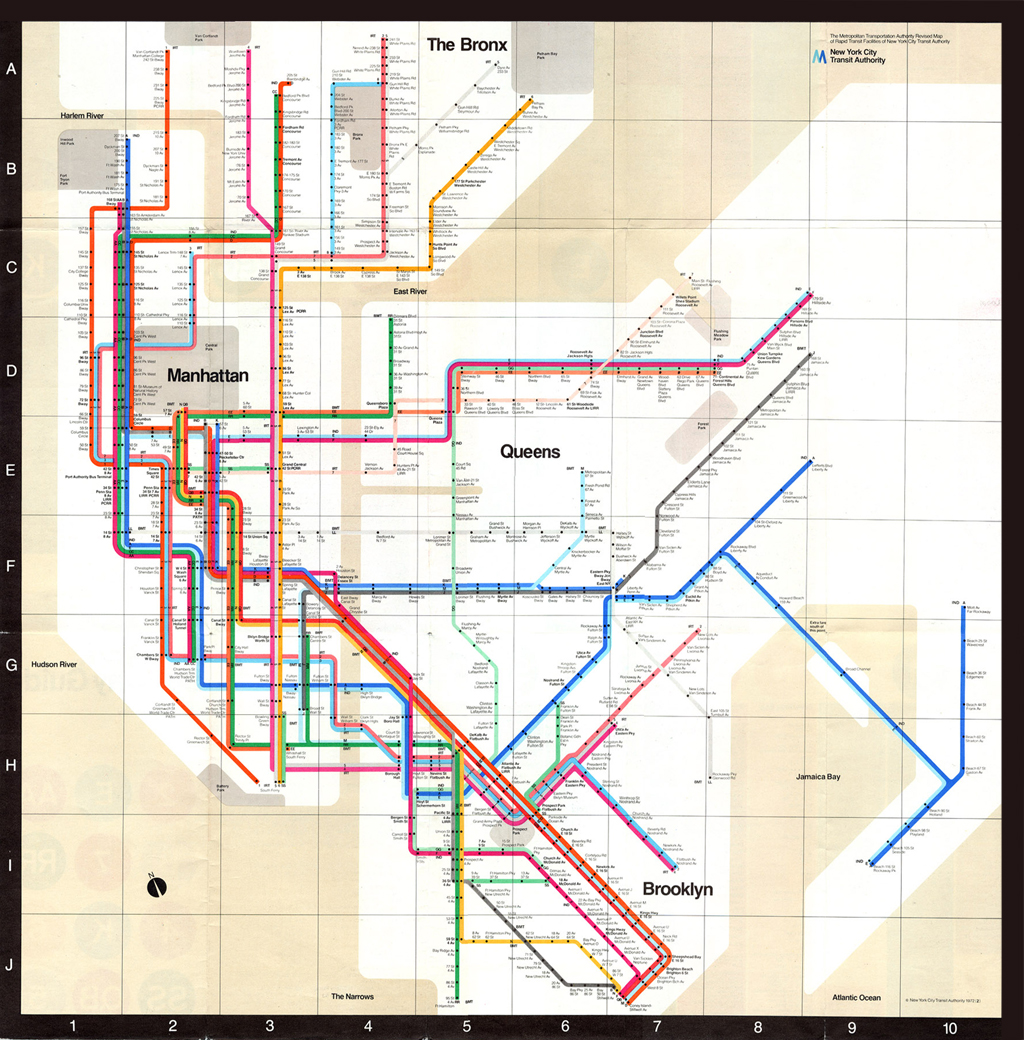
Going back on the idea of imitating vs emulating, Kleon provides a list of the differences between the two in a "good theft" and "bad theft" chart. Prior to this post, I had stated that I wanted to use Chipp Kidd as a mentor, but even though he is an amazing designer, I think I'm going to change it to Massimo Vignelli. I find that when I do projects that are more open ended, I tend to emulate swiss style design. I just love how simple and clean the style is and how it reduces images to the most basic forms. I plan on using the chart to study Vignelli's work by making sure I study as many pieces I can by him and try to keep his style in mind when designing my next "open ended" project. One of his most iconic works is his rendition of the New York City subway system:


I tried coming up with something that emulate this work and this is what I came up with:


Yes, I included Pluto because Pluto will always be a planet to me :) and yes, the spacing is (to the best of my ability) to scale based on the perihelion values (except for Pluto).


Thursday, February 5, 2015

Reading

On page 20 of "Steal Like an Artist", Kleon suggests that one should always be reading. I couldn't agree more as reading not only expands your ideas, but also can help you be articulate when speaking and also become a good writer. Unfortunately, I know I do not read nearly enough as I should be. Growing up my parents owned a small restaurant and so they did not have the time to read to me, so I just watched TV as they worked all day. That got me into the bad habit always preferring to watch TV or playing video games over reading. I am convinced that I would be more expressive with my ideas, be able to debate better, have a better memory, and be a better writer if I had read more as a child and as an adult. At one point I did get better and read ever night before bed, but then my mom insisted on getting me an iPad (cause that's what all the cool people got) and it all downhill from there. 

I went to Parkland's library and got some books that seemed interesting to me. Some of them are design books, but the others are kind of random, but seem intriguing based on their covers and/or description. The one I will probably read is one of the design books since I could apply it to my classes, and since I will be graduating soon, I could use all the design related knowledge I can get. 


There are also a bunch of books that I have been wanting to read but just haven't gotten around to it yet. Some of them I was supposed to read in high school, but never did in my classes for some reason. Others I have seen other people read, and therefore I want to read as well. Here are some that come to mind, but I will probably try reading the books I already have at home before going out and buying any of these.


In the back of "Steal Like an Artist", Kleon made some recommendations on what books to read. After looking up what each one was about, I am eager to get a hold of "Rework" by Jason Fried and David Heinemeier Hansson, and "Ignore Everybody" by Hugh MacLeod. Both of them sound interesting to read and can hopefully help and/or improve my creative process and to help me think more like a designer. 

I really hope that when my life becomes stable, hopefully with a decent job, that I will start reading regularly. The covers and descriptions can be so interesting, but I just have a hard time focusing all my attention on reading text for a long period of time, but I really want to. This is also probably the source of my procrastination problem now that I think about it, or at least part of it. Perhaps tonight I will try to go to bed at a decent hour and read for a bit.